
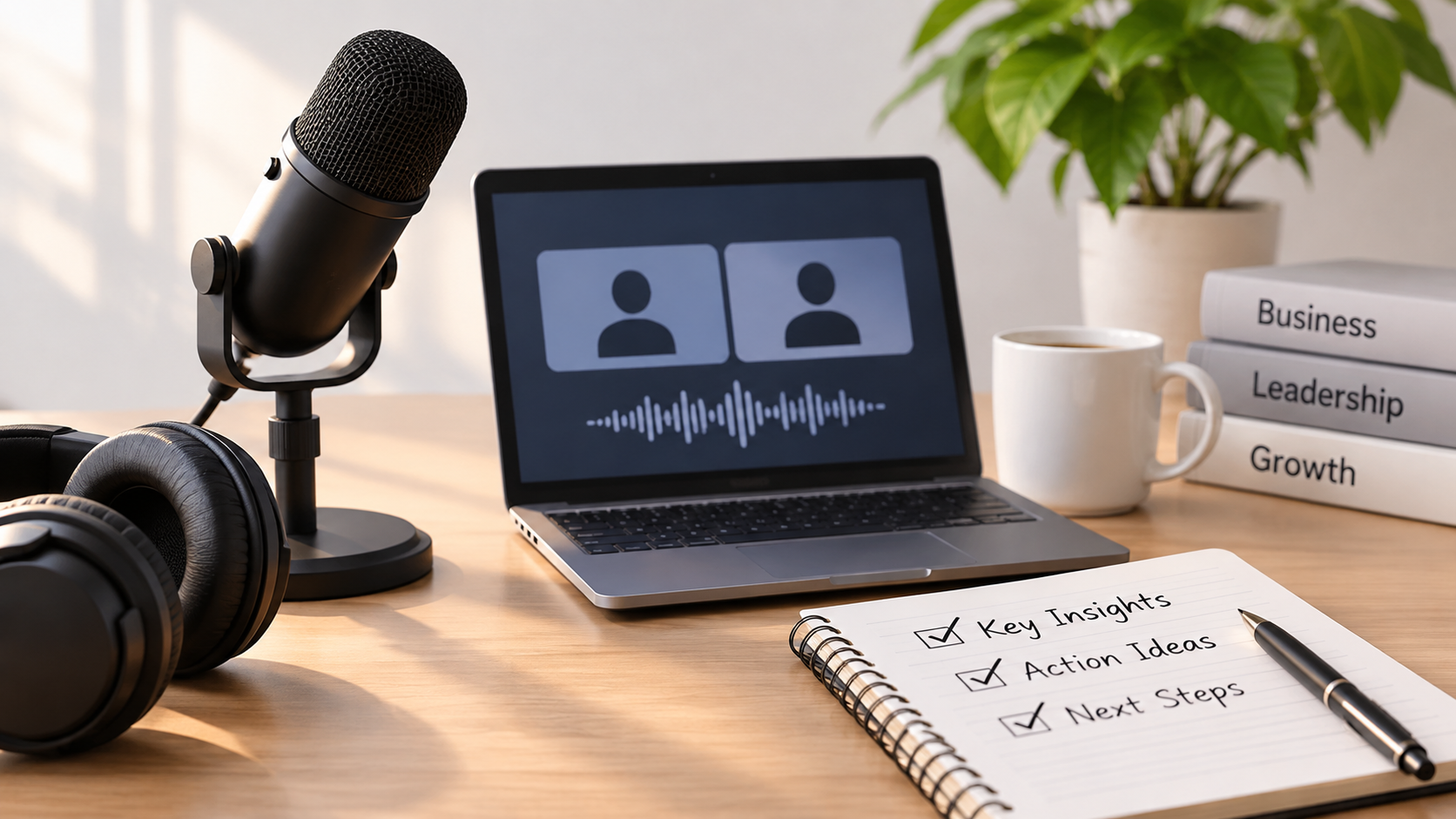
Most people start a podcast for the audience. They want downloads, reach, and a way to share what they know.
Those goals are fine. But they can cause you to miss one of the biggest returns a show gives you: what you learn as the host.
Podcast interviews are one of the best ways to learn from experts because they give you direct, one-on-one access to people who are ahead of you. You choose the questions. You follow up when an answer is vague. You hear how experienced people think through real decisions, which is hard to get from a book, a course, or a 60-second clip.
Quick answer: Podcast interviews help you learn from experts by giving you direct access to people with real experience. You ask your own questions, follow up in the moment, and hear the reasoning behind their decisions. For founders, that turns each episode into a focused learning session that can sharpen decisions and build relationships.
Table of Contents
- What I Learned Publishing Every Day for a Year
- Why Interviews Teach Differently Than Books or Courses
- What Makes an Interview Worth Learning From
- How PodUp Helps You Keep the Conversations Coming
- How to Turn Interviews Into a Personal Learning System
- Common Mistakes
- A Simple 5-Step Plan
- Key Takeaways
- FAQ
What You'll Get
- A clear reason to treat podcast interviews as a learning system, not just content
- A set of question types that pull real lessons out of expert guests
- A five-step plan to apply what you learn after each episode
What I Learned Publishing Every Day for a Year
On February 5, 2021, I started the Monetization Nation podcast and committed to publishing every day for a year. When the year ended, my team and I made a list of the biggest lessons we learned. The first one surprised me most.
I loved learning from successful entrepreneurs and experts in our business and marketing niche. Where else could I get leading experts to give me an hour of their time, one-on-one, for free?
I underestimated this when I started. In those interviews, I could ask whatever I wanted from people who knew far more than I did in their areas. After a year of doing it, it felt like I'd earned my own "online show MBA."
That's the lesson. Your show is content for your audience. It's also an education for you.
Why Interviews Teach Differently Than Books or Courses
Books and courses are valuable. But they're fixed. The author decided what to include long before you showed up.
An interview responds to you.
You set the agenda
You can ask about the exact problem you're facing this quarter. If a guest built a sales team, you can ask how they hired their first rep, what they paid, and what they'd change.
You get the story behind the lesson
Polished advice often hides the messy part. In a conversation, you can ask, "What went wrong first?" That's usually where the real lesson lives.
You can follow up
When an answer is broad, you can ask for an example. When a guest mentions a turning point, you can stay on it.
| Learning source | Strength | Limitation |
|---|---|---|
| Books | Deep, structured thinking | Can't answer your follow-up |
| Courses | Step-by-step teaching | Built for a general student |
| Short-form content | Quick ideas | Little context |
| Podcast interviews | Live answers to your questions | Depends on your preparation |
What Makes an Interview Worth Learning From
Some conversations teach you more than others. The difference usually comes from the host.
Start with real curiosity
Pick guests whose experience you actually want. If you'd pay to have coffee with them, they're a good fit.
Ask specific questions
"How do you grow a business?" gets a general answer. "What did you change when revenue stalled at $1 million?" gets a story.
Listen for the line worth slowing down for
The best moments often come mid-answer. When a guest says something surprising, pause the next question and ask, "Tell me more about that."
Questions that tend to produce real lessons
- What did you get wrong early on?
- What decision would you make differently today?
- What do most people in your field misunderstand?
- What's one thing you'd focus on if you were starting over?
For help choosing the right people to ask, see find and book great podcast guests.
The relationship is part of the return
An interview also starts a relationship. Many guests become advisors, partners, or friends. We cover that in build long-term relationships with podcast guests.
How to Turn Interviews Into a Personal Learning System
One great conversation can change how you think. A system makes that happen on purpose, week after week.
Keep a lessons log
After each episode, write three things: the most useful idea, the question that produced it, and one way you'll apply it. Over a year, that log becomes a playbook built from dozens of experts.
Review the transcript
Your memory of a conversation fades quickly. A transcript lets you go back to the exact words, catch details you missed, and pull quotes for later.
Connect the dots across guests
When several guests say similar things, you've found a pattern worth trusting. When they disagree, you've found a decision worth thinking through.
Share what you learned
Turning a lesson into a short post or email helps you remember it and shows your audience you're applying what you hear.
How PodUp Helps You Keep the Conversations Coming
The learning only continues if the show keeps publishing. PodUp is an all-in-one platform that brings recording, publishing, and promotion together with more than 70 integrated tools. Its AI-powered Repurposer turns each interview into more than 25 content pieces, including clips, a blog article, a newsletter draft, and a transcript you can review for lessons later. Less production work means more of your time goes into the conversations themselves.
Common Mistakes
Trying to sound smart instead of learning
Some hosts spend the interview proving they belong. The cost is fewer questions asked and less learned from someone who could have taught you a lot.
Asking only broad questions
General questions produce general answers. The cost is an episode that sounds fine and teaches little.
Skipping preparation
Without research, you can't ask the follow-up that matters. The cost is missing the guest's best stories.
Treating the episode as content only
If you don't review what you learned, the lesson fades. The cost is losing the biggest personal return a show can give you.
A Simple 5-Step Plan
- Choose guests for depth. Invite people whose experience solves a problem you care about.
- Prepare questions you want answered. Write three you'd ask even if you were the only one listening.
- Listen for the turning points. Slow down when a guest shares a mistake or a decision.
- Capture the lesson right away. Write one takeaway within an hour of recording.
- Apply one thing before the next episode. Test one idea in your business each week.
Key Takeaways
- Podcast interviews give you direct, one-on-one access to experts.
- You can ask follow-ups that books and courses can't answer.
- Preparation and specific questions produce the best lessons.
- A simple lessons log turns each episode into lasting education.
Treat Your Show Like Your Classroom
A podcast can grow your audience. It can also grow you. Each guest you interview is a chance to learn from someone who's already solved a problem you're facing. Prepare well, ask better questions, and apply what you hear.
If you want an all-in-one place to create, grow, and monetize your podcast, sign up for PodUp here: www.PodUp.com.
Comments